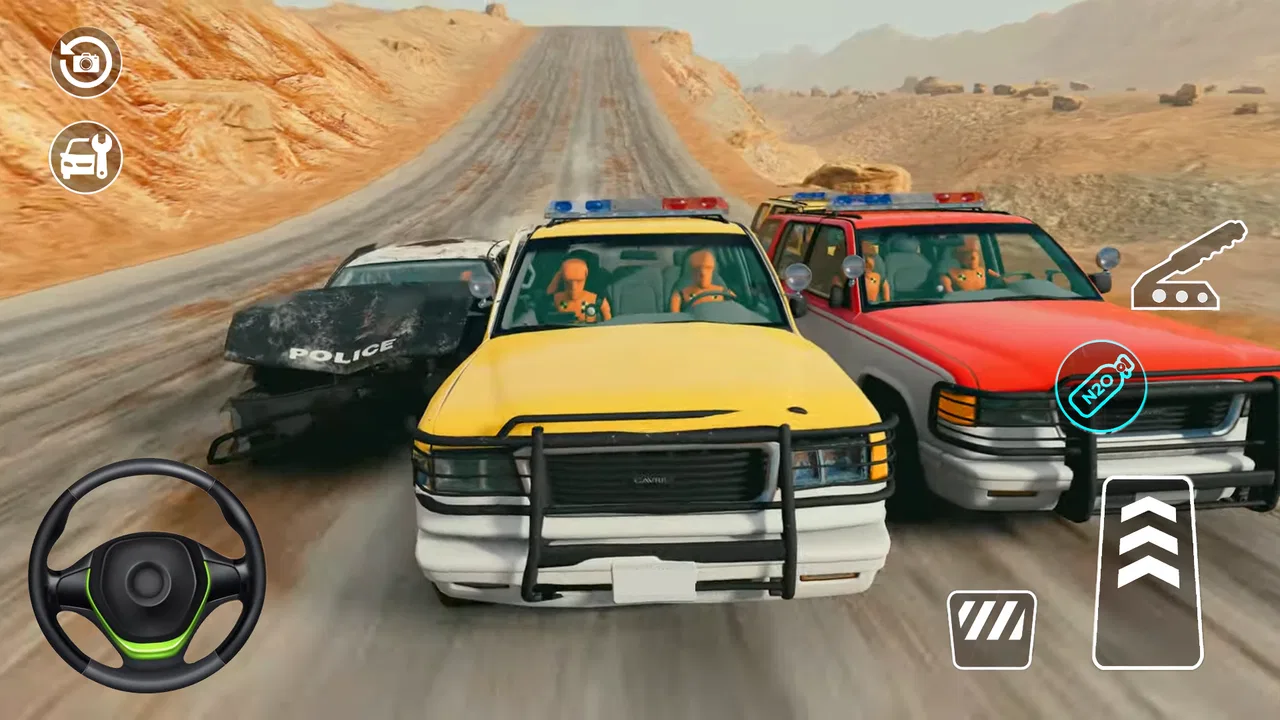
Jumping Car Damage Test Game
- 4.2
- Rating
- 5.00M
- Installs
- Free
- Price

 Analysis by App-foxy
I spent time with Jumping Car Damage Test Game, a free simulation game from SpeedZone that focuses on one simple idea: send a car into the air, bring it back down, and enjoy the visual drama of the crash. It is not trying to be a full driving simulator or a structured racing game. Its appeal is much more immediate. You choose the moment, commit to the jump, and watch the result unfold.
That simplicity is both its strongest quality and its biggest limitation. I can open it when I want a quick burst of silly driving entertainment, without learning a complicated control system or following a long campaign. At the same time, players looking for realistic vehicle handling, deep progression, or competitive racing may find the experience too narrow. My overall impression is that this is best understood as a casual car playground rather than a traditional driving game.
How the current version feels in everyday use
The game is listed in the simulation category, although its approach is much more playful than technical. The central pleasure comes from setting up a jump and seeing how the car reacts when the landing goes wrong. That gives each attempt a small experimental quality: I naturally start wondering whether a different approach, speed, or launch angle will create a more satisfying result.
You May Also Like

 Blood Strike: 2.5 Anniversary
Blood Strike’s Loadouts Turn Every Drop Into a Tactical Gamble
A close look at Blood Strike’s custom loadouts: how fast access to signature weapons reshapes its battle royale rhythm, rewards preparation, and narrows the gap between fights.

 Pandora - Music & Podcasts
Pandora’s Music Is Easy to Start, but Harder to Recover
Pandora’s strength is its low-effort path from a seed to a station. Its weak spot is how much confidence it asks you to place in connection, setup, and quiet recovery.

 8 Ball Pool
 Is Built on Rivalries, Rematches, and Routine
A close look at the rivalries, rematches, shared routines, and unanswered safety questions that turn a quick pool match into a persistent mobile community.

 Samsung Music
’s Quiet Strength Is Playing What You Already Own
Its reach comes less from spectacle than from dependable access to a personal library. That simplicity is both the app’s strongest retention engine and its ceiling.

 AccuWeather: Weather Radar
AccuWeather Review: A Quick, Clear Forecast for Everyday Decisions
For everyday plans, the best forecast is the one you can understand quickly. AccuWeather makes rain timing, radar, and local conditions easy to act on, with a few trade-offs.

 Hill Climb Racing
Why Hill Climb Racing Still Turns Crashes Into One More Run
A tiny car, a bumpy hill and one more upgrade: Hill Climb Racing keeps resurfacing because its simple chaos makes every near-miss feel personal.
More From Our News Desk



It works particularly well in short sessions. A realistic everyday use case would be opening it while waiting for an appointment, taking a brief break from work, or handing the phone to a friend who wants to try something without reading instructions first. The concept is easy to understand almost immediately, which makes the game accessible to people who do not normally spend time with driving titles.
The store summary presents it as an ultimate car jump and crash experience, while the short description reduces the idea to “Jumping Car.” Those descriptions are brief, but they point toward the correct expectation: the game is built around the jump itself, not around a large collection of unrelated activities. I would not install it expecting a broad open world, a detailed career mode, or a serious racing ladder.
SpeedZone has also positioned it as a widely accessible free game. It is suitable for Everyone, supports devices running Android 6.0 or later, and has passed the early discovery stage with more than five million installs. Its average rating is 4.2 from roughly twelve thousand ratings, which matches my impression that the straightforward crash-play concept has a clear audience, even if it will not satisfy every type of mobile driver.
The current release is version 1.2.2. That matters because the game feels like a focused product that has already moved beyond its initial launch rather than a completely untested experiment. It was released on December 11, 2024, so I see it as a relatively young title whose identity is already clear but whose longer-term direction is still worth watching.
The core loop rewards curiosity more than precision
What kept me playing was not a conventional win condition. I was interested in trying another jump because the outcome itself was entertaining. That distinction is important. In a racing game, a failed corner usually feels like lost progress. Here, an awkward landing can be the reason to try again.
I found it useful to treat every attempt as a small test rather than as a demand for perfection. First, I would make a straightforward jump to understand the situation. Then I would change one part of my approach and compare the result. This makes the game more enjoyable than simply repeating the same action without paying attention. It also gives the experience a little more depth than the short store description suggests.
One practical tip is to avoid rushing through attempts just because the controls seem simple. The best casual sessions came when I paused briefly before committing to a jump and decided what I wanted to learn from it. Was I testing distance, timing, or the way the vehicle handled the landing? That small habit turned random crashes into a more engaging loop.
Another useful approach is to play in short bursts and stop when the novelty fades. Because the game is centered on one main fantasy, extended sessions can feel repetitive if I expect constant new objectives. It is more satisfying when treated like a quick toy: open it, create a few entertaining crashes, experiment with a different approach, and return later.
What the version history means for players
Version 1.2.2 is the release I would judge today, not an older launch build. For a player deciding whether to try it, that means the relevant question is whether the current focused experience sounds appealing, rather than whether the first release had enough content for long-term play. The product has had time to establish its basic direction, but I would still approach it as a compact casual game instead of assuming it has grown into a large driving package.
The release date also helps set expectations about evolution. A newer game can feel more like a work in progress than a mature genre leader, especially when its main idea is deliberately small. I would be comfortable recommending it to someone who wants the central jump-and-crash activity now. I would be more cautious with someone choosing a game specifically for years of progression, because the value here depends heavily on whether the core stunt remains amusing after repeated attempts.
For existing users, the current version is a reason to judge the game on its present handling and replay value rather than on assumptions about future additions. I would not tell a friend to install it solely because it might eventually become a larger simulator. The sensible decision is to enjoy what is already there and treat future development as a bonus, not as part of the purchase decision.
That is also where the free price helps. There is little commitment involved in trying it, so the game can earn its place through immediate entertainment. Free does not automatically make a repetitive game worthwhile, but it lowers the risk for curious players who want to see whether crash-focused driving fits their taste.
Who will enjoy it, and who should choose something else
I think it is a good match for casual players who like vehicle stunts, exaggerated mishaps, and quick experiments. It may also suit younger players within the Everyone rating, provided they are looking for playful car action rather than a realistic lesson in driving. The simple premise makes it approachable, and the absence of a need to master a large ruleset is a genuine advantage when sharing a phone with a friend or family member.
It is less suitable for someone who wants licensed cars, detailed tuning, traffic-filled roads, serious competition, or a carefully structured story. If your favorite part of a driving game is shaving time off a lap, building a garage, or adjusting a vehicle for a specific track, a conventional racing or driving simulator will probably be a better choice. This title is about the spectacle of the jump and the crash, not about replacing those other formats.
I would also skip it if you need a game with a strong sense of long-term purpose. The main activity can be enjoyable without a traditional campaign, but players who need missions, unlocks, or a steadily expanding challenge may find the loop too light. That is not a flaw in concept; it is simply the trade-off for being so easy to start.
Compared with ordinary racing games, this one removes much of the pressure. There is no need to defend a position through several laps or memorize a complicated circuit before having fun. Compared with a serious simulation, it favors immediate amusement over technical accuracy. Compared with a physics sandbox, it offers a more directed car-jump fantasy rather than an open-ended construction project. Those comparisons explain its place clearly: it is a compact stunt toy for mobile sessions.
Small habits that make the experience better
The first habit I recommend is changing only one variable at a time. If I alter speed, timing, and approach together, I cannot tell why the landing changed. Testing one adjustment makes the crash more informative and gives the game a light problem-solving layer. This is especially helpful when the initial novelty starts to wear off.
The second is to use the game as a social pass-and-play activity. Instead of asking another person to understand a complicated control scheme, I can give them a simple challenge: attempt a jump, then try to create a more surprising result. This works because failure is not embarrassing in the same way it can be in a competitive racing game. The crash is often the entertaining part.
The third is to separate “successful jump” from “interesting jump.” A clean landing may feel satisfying, but a dramatic mistake can be equally valuable in this particular game. That mindset prevents me from judging every attempt by conventional driving standards. I found the experience more enjoyable once I accepted that the goal was not always to drive well; sometimes it was to discover what happened when the plan went badly.
A fourth consideration is device compatibility. Android users need version 6.0 or newer, so anyone with an older phone should check that basic requirement before planning to play. On supported hardware, the game’s short-session design makes it a sensible candidate for a spare device or a quick-install library, but I would still leave enough storage and battery for normal mobile gaming rather than treating compatibility as a guarantee of identical performance on every handset.
Where the current experience still feels limited
The focused design can become repetitive. Once I understand the basic pleasure of launching and crashing a car, the game needs variety in the situations, goals, or outcomes to keep demanding my attention. If I am playing for only a few minutes, that is not a serious problem. If I want a full evening of driving, the narrow loop becomes much more noticeable.
There is also a difference between visual crash entertainment and a deep damage simulation. The name and premise may attract players who expect detailed mechanical consequences, but I would not approach it as a professional vehicle-testing tool. The fun comes from the game’s stunt scenario, not from using it to understand real-world crash safety or authentic automotive engineering.
Another limitation is motivational rather than technical. A player who needs clear milestones may wonder what to work toward after the initial experiments. I personally found the freedom to retry appealing, but that same freedom can feel directionless to someone who prefers explicit objectives. Before installing, it helps to decide whether you enjoy self-directed play or need the game to tell you what comes next.
The age rating of Everyone makes the game broadly approachable, but it also signals that this is not designed around mature storytelling or intense realism. Players seeking a darker crash-focused experience should look elsewhere. Here, the framing is casual and accessible, which supports quick family-friendly play but limits the emotional and thematic range.
What I would watch as SpeedZone continues development
For future updates, I would pay attention to whether SpeedZone expands the central idea without burying its simplicity. New ways to approach jumps, more meaningful reasons to repeat attempts, or additional forms of experimentation could give experienced players a reason to return. The best direction would preserve the instant accessibility while adding enough variation to prevent the main stunt from feeling exhausted.
I would also watch how the game handles the balance between simulation language and arcade behavior. The simulation label can attract people expecting realistic vehicle responses, while the crash-play concept appeals to people who want exaggerated fun. Clearer alignment between those expectations would help players understand the experience before downloading it.
Existing users should judge updates by practical improvements to replay value rather than by version numbers alone. A new release is most useful when it gives me something meaningful to test, changes how I approach a jump, or makes short sessions feel less predictable. I would welcome evolution, but I would not want unnecessary complexity to turn a quick mobile diversion into a slow, demanding simulator.
My recommendation after playing
My recommendation is straightforward: try it if you want a free, easy-to-start car stunt game whose main reward is watching jumps and crashes play out. The current version has a clear identity, and the accessible age rating and Android support make it easy for a broad audience to consider. The strong install count and solid average rating suggest that the concept has found plenty of interested players, though popularity alone cannot remove the repetition issue.
I would recommend it most strongly as a short-session game, a casual experiment, or something to share with a friend. I would not recommend it as a replacement for a full racing simulator, a competitive driving game, or a long-form progression title. Its value comes from doing one thing quickly and invitingly, not from pretending to cover every part of the driving genre.
In the end, Jumping Car Damage Test Game works when I approach it on its own terms. I enjoy it more when I stop looking for a complete driving career and focus on the small question behind each attempt: what will happen if I try this jump differently? If that question sounds fun to you, the free download is an easy experiment. If you need depth, realism, or a large set of objectives, your time will be better spent with a more traditional alternative.
FAQs for Jumping Car Damage Test Game
01What is Jumping Car Damage Test Game?
Jumping Car Damage Test Game is a vehicle stunt and crash-testing experience focused on launching cars over ramps, obstacles, and gaps to observe how they perform and break on impact. Instead of following a traditional racing campaign, players generally experiment with jumps, collisions, and destructive scenarios while trying to create spectacular crashes and achieve the best results.
02How do you play Jumping Car Damage Test Game?
Gameplay is usually based on selecting a vehicle, choosing a stunt or testing environment, and controlling acceleration, steering, and jump timing. The main challenge is building enough speed to clear ramps while keeping the car stable in the air. After landing or crashing, you can review the damage and try different approaches, vehicles, or obstacle combinations.
03Is Jumping Car Damage Test Game suitable for children?
The game may be suitable for older children and casual players who enjoy simple driving and crash simulations, but parents should review the content before allowing younger children to play. It includes repeated vehicle destruction, collisions, and stunt impacts. Although the damage is presented as fictional game physics, it may not be appropriate for children sensitive to crash-focused gameplay.
04Does Jumping Car Damage Test Game require an internet connection?
An internet connection may not be necessary for the core driving and jumping activities, especially if the game has already been installed and its main assets are available on the device. However, advertisements, optional updates, analytics, leaderboards, or other online features can require connectivity. Availability of offline play may also vary between versions and devices.
05Are there in-app purchases or advertisements in Jumping Car Damage Test Game?
Many free mobile stunt and damage-test games are supported by advertising, so you may encounter banners, interstitial videos, or rewarded ads while navigating menus or restarting challenges. Some versions can also include optional purchases for removing ads, unlocking vehicles, or accessing extra content. Check the store listing and payment settings before downloading, particularly on a shared device.
Pros
- Simple controls make it easy to start playing immediately.
- Vehicle crashes and deformation effects make jumps visually entertaining.
- Short challenges are suitable for quick gaming sessions.
- A variety of cars and ramps adds some replay value.
- Works well as a casual game for players who enjoy stunt experiments.
Cons
- Gameplay can become repetitive after trying the main ramps.
- Some vehicles or upgrades may require extended play or purchases.
- Physics occasionally feel inconsistent during landings and collisions.
- Ads may interrupt the experience
- especially between attempts.
- The game offers limited depth for players seeking racing competition.

Jumping Car Damage Test Game
Gallery